PRACTICAL PREPAREDNESS. PEACE OF MIND.

Store It. Source It.
Treat It. Test It.
Plan It.

The Honest, Step-by-Step Guide to Home Water Independence

Be ready for the next boil-water notice, outage, storm or dry summer. A researched, plain-English blueprint for keeping your household prepared.

One-time payment · Instant PDF download · 3 bonus guides

Explore the 5-Layer Plan
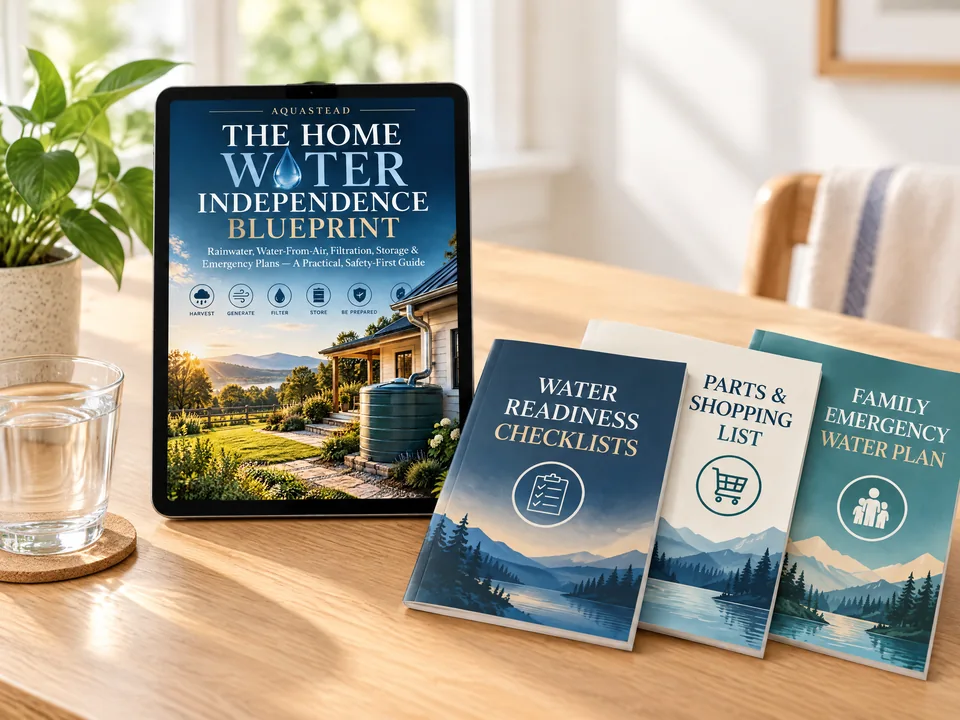
AquaStead digital blueprint on a tablet with its three printable bonus guides on a sunny kitchen table
THE BLUEPRINT + 3 PRINTABLE BONUSESDigital PDFs
Good plans beat guesswork.Start with one sensible weekend.
Store with confidenceYour household’s needs, safely covered.
Source with real numbersRainwater, wells & water from air.
Treat & test properlyKnow what works. Know for sure.
Secure checkout60-day money-back guaranteeNo subscription, everGrounded in primary guidance
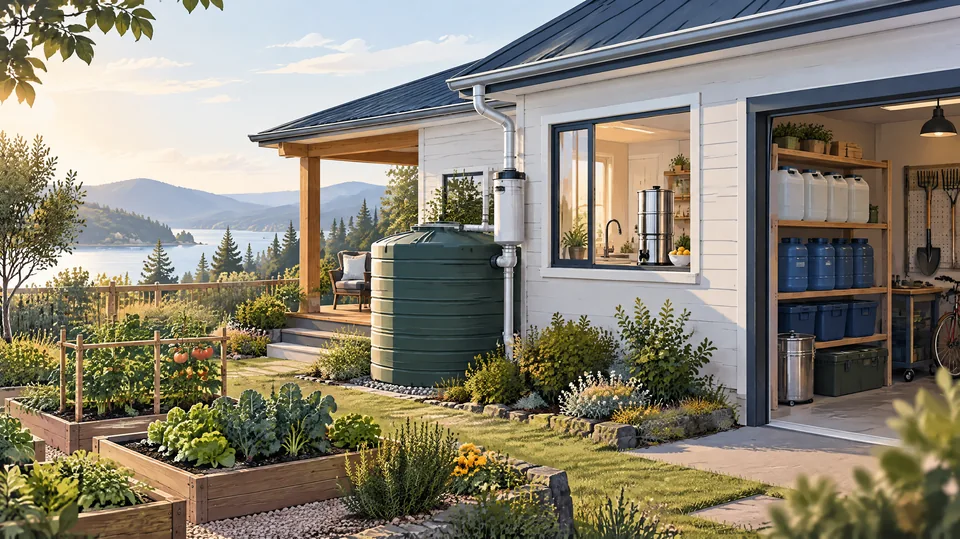
A calm home with a covered rainwater tank, labelled water containers and a kitchen filter

A LITTLE PREPARATION.

A lot more peace of mind.

Illustrative home water setup

01 A FAMILIAR KIND OF TUESDAY

Prepared for plenty.
But not for the tap to stop.

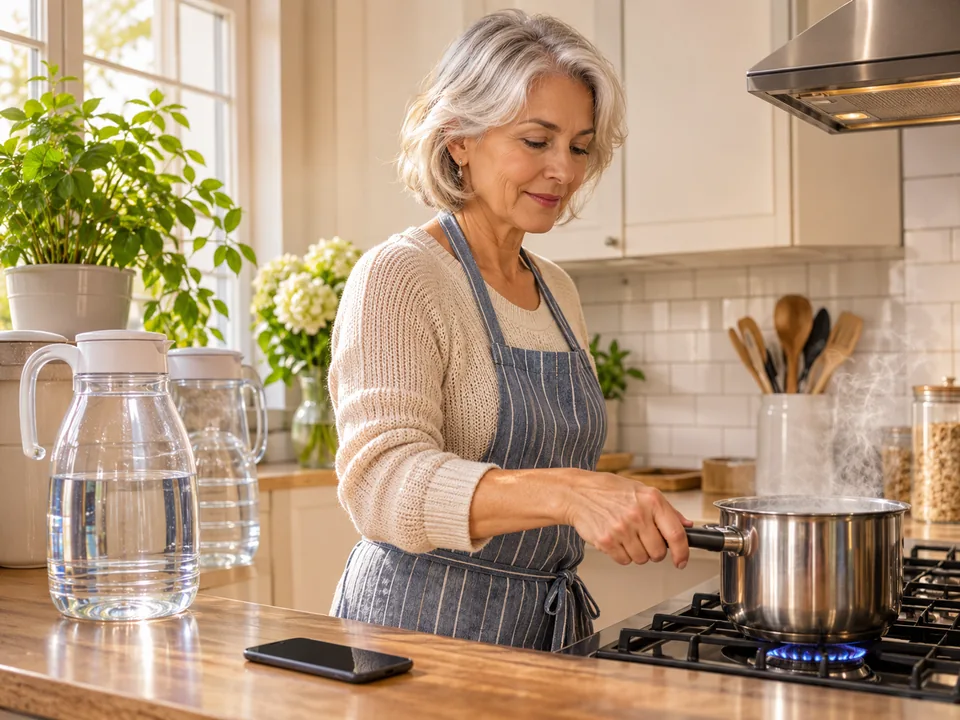
Illustrative composite scenario: a woman in her kitchen waiting for water to boil
Illustrative scenario. This is a composite story based on common experiences, not a real customer.

"It was a Tuesday. Nothing dramatic. That's the part that surprised her."

Picture a woman we'll call Linda. She's 61, lives in a tidy suburb, and is the sort of person who keeps spare batteries in a labelled drawer.

At 7:40 one morning a text arrives from the local water utility: a water main has broken. Customers in her area are under a boil-water advisory until further notice.

She isn't scared. It's just water, and the utility will fix it. Then the small questions start piling up:

  • Can she brush her teeth with tap water? (No. The CDC says to use boiled or bottled water for that during an advisory.)3
  • What about the ice already in the freezer? The coffee maker? The dishwasher?
  • Her grandson is staying over. Is the water OK for his bath?
  • How long does she actually boil it? Does a quick boil count?
  • The store shelf where the bottled water usually sits is half empty by lunchtime.

The advisory lasts three days. Nobody gets hurt. Linda is fine.

But on day three, standing at the stove waiting for a pot to boil again, she realises something. She's a prepared person, and she still had no plan for water. She had a vague idea about "keeping some bottles around". She had no idea how much she needed, how to store it so it stays good, or what she'd do if the outage had come with a storm and the power had gone too.

If this sounds familiar, you're far from alone.

ORDINARY INTERRUPTIONS. A SENSIBLE RESPONSE.

Why have a water plan?

Public water in the US, Canada, UK and Australia is among the safest in the world. Most interruptions are short. A little preparation still makes sense.

Linda's Tuesday is ordinary, and that's exactly the point:

  • Roughly 4,000 boil-water advisories were identified across the United States in a single year (2021) in the EPA's 2024 Report to Congress. About 80% came from main breaks, distribution repairs or loss of water pressure, the everyday wear and tear of a water system.1
  • America's drinking-water pipes have a lot of miles on them. The American Society of Civil Engineers' 2021 Infrastructure Report Card estimated a water main break about every two minutes in the US.6
  • Power outages affect water too: well pumps, pressure tanks and some utility pumping stations all need electricity. The US Energy Information Administration reports that in 2024 the average US electricity customer went about 11 hours without power, nearly double the previous decade's average, and most of those hours came during major storms.5
  • Drought comes and goes. In late August 2025, about 65% of the western United States was classed as being in drought on the US Drought Monitor.7 Australians, and anyone who has lived through a UK hosepipe ban, know the feeling.

None of this is a reason to panic. Public water in the US, Canada, the UK and Australia is among the safest in the world, and most interruptions are short.

It's a reason to have a plan, the same way you have a spare tyre, a first-aid kit and a torch in the drawer.

The goal isn't to "go off-grid" or to live in fear. It's to make sure that when the tap does something unexpected, your household shrugs and gets on with the day.

02 LESS NOISE. BETTER ANSWERS.

A real system.
Not another internet rabbit hole.

If you've tried to research this already, you've probably run into one of these three problems.

01

The generic list

"Store one gallon per person per day." Fine. It's a good start, and it's straight from the CDC.2 Then what?

  • What kind of container? (Not old milk jugs. We explain why.)
  • How do you clean and sanitise it?
  • How often do you rotate it? The CDC says every 6 months if you fill containers yourself.2 How do you remember?
  • Where do you put 14 gallons for each person when a full 55-gallon drum weighs around 460 lb?
  • What about pets, medical needs, a hot climate, or a family member who's pregnant or unwell?

Generic lists give you a number. They don't give you a system.
02

Unsafe DIY

Online forums are full of confident advice that's flat-out risky:

  • "Rainwater is pure, so just drink it." It isn't automatically safe. The CDC is clear that rainwater "is not necessarily safe to drink without first removing germs and chemicals from it."4 Your roof, gutters, bird droppings and flashing all affect what ends up in your barrel.
  • "Boiling makes any water safe." Boiling kills germs, but it does not remove chemicals.3 It won't remove nitrates, metals, fuel or algal toxins either.
  • "Just tee your rain tank into the house plumbing." Connecting a non-potable supply to drinking-water pipes without proper backflow prevention can contaminate your home's water, and in many places your neighbours' too. It's also usually against plumbing codes.
  • "Any blue barrel will do." Not if it once held industrial chemicals.
03

The "water from thin air" overpromise

You may have seen ads promising "unlimited free water from the air" with a cheap DIY gadget.

Here's the honest truth: pulling water from air is real physics, and a dehumidifier does it every day. But it takes a lot of energy, and it depends heavily on humidity and temperature. Research on atmospheric water generators has measured energy use from roughly 1 kWh per litre in warm, humid conditions to over 6 kWh per litre in cool conditions.9 In dry or cold weather, yields drop sharply.

Atmospheric water can be a useful supplement in the right climate, but it isn't free and it isn't unlimited. And water from a dehumidifier is not drinkable without treatment.

AquaStead was written to fix all three problems: a real system instead of a list, safety-first methods instead of forum folklore, and honest numbers instead of hype.

03 THE AQUASTEAD METHOD

Five layers.
One calmer
household.

Most people think about water as one thing: “Do I have some or not?”

Resilient households think in layers. If one layer fails, the next one catches you.

Build from the bottom up.
Let each layer support the next.

  1. LAYER 1

    Store

    Clean water already in the house, ready the moment you need it.

    How much to keep (starting from the CDC's 1 gallon per person per day, at least 3 days, 2 weeks if possible)2, which containers to use, how to sanitise and label them, where to keep them, and a rotation system you'll actually stick to.

  2. LAYER 2

    Source

    A way to refill when storage runs low.

    Rainwater harvesting, from a single barrel to a full tank. Private wells and hand pumps. Atmospheric water, explained honestly. Plus the "hidden" emergency water already in your home (your water heater can hold 30–80 gallons) and what not to use.

  3. LAYER 3

    Treat

    Turning "water" into "water you can drink".

    The multi-barrier approach professionals use: settle, pre-filter, filter, disinfect. Exact procedures for boiling, household bleach, UV, gravity filters and distillation, plus how to read NSF/ANSI certifications so you know what a filter really removes.

  4. LAYER 4

    Test

    Because you can't see bacteria, nitrates or lead.

    What to test, when, and how, from home test strips to certified labs. How to take a proper bacteria sample. How to read results against EPA, WHO and Health Canada guideline values. What to do if a test fails.

  5. LAYER 5

    Plan

    Knowing exactly what to do, and who does it, when the tap changes.

    Step-by-step playbooks for boil-water advisories, do-not-drink notices, multi-day outages, hurricanes, floods, wildfire, winter storms, earthquakes and drought restrictions. Includes evacuation water and planning for children, older relatives and pets.

Storage covers the first few days. Sourcing covers longer gaps. Treatment and testing make sure what you collect is fit for its purpose. The plan ties it together so nobody’s guessing at 7:40 on a Tuesday morning.

04 FROM THE FIRST BOTTLE TO THE BIGGER PICTURE

Open the guide.
Find your next practical step.

A fully illustrated PDF with 12 chapters, worked examples, build sheets, real cost ranges and safety guidance drawn from CDC, EPA, WHO and recognised standards bodies.

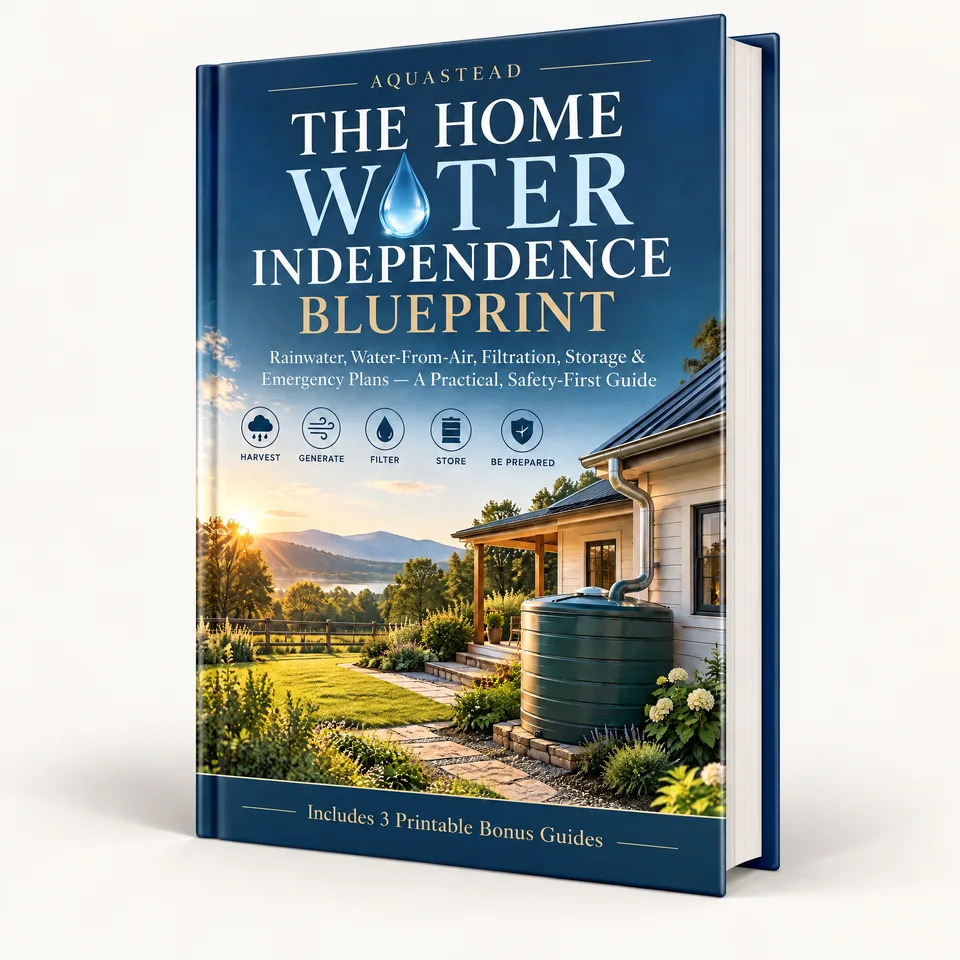
The AquaStead Home Water Independence Blueprint book mockup; purchase is a digital PDFDigital guide · Print at home

WRITTEN TO BE USED, NOT JUST READ

Your “what do I do next?”
book for the kitchen drawer.

Start small with the first-weekend plan. Then go as far as your home, climate and budget make sensible.

  • Build sheets from a single barrel to an IBC tote
  • Treatment methods and their limits, side by side
  • Tank weights, harvest formulas and honest costs
  • A source list at the end of every chapter
Take a look inside
00

Before You BeginHow to Use This Blueprint Safely

  • The "first weekend" quick-start: the handful of jobs that move a household from zero to a sensible 72-hour water baseline in about two days
  • Potable vs. non-potable: the single distinction that prevents most DIY water mistakes
  • A plain-English safety section on permits, cross-connections, and when to call a licensed plumber or electrician
01

Know Your WaterThe Household Water Audit

  • How much water your household uses compared with how much it needs in an emergency (these are very different numbers)
  • How to read your water meter and bill to find your real daily use
  • A worked household calculator with pets, medical needs and hot-weather adjustments built in
  • How to set goals that suit your situation: 72 hours, 2 weeks, 30 days, or garden independence for the season
02

Rainwater Harvesting IRoofs, Gutters, First-Flush and the Rules

  • The harvest formula every homeowner should know: 1 inch of rain on 1,000 sq ft of roof ≈ 623 US gallons (metric: 1 mm on 1 m² = 1 litre)
  • Which roof materials are good for collection, and which ones to think twice about
  • Why the first flush of every storm is the dirtiest water you'll catch, and how a simple diverter sends it away
  • The legal patchwork, explained calmly. Colorado, for example, allows up to two barrels totalling 110 gallons per household, for outdoor non-potable use only.8 Many other states actively encourage collection. Plus notes for Canada (CSA B805), the UK (BS EN 16941-1) and Australia
03

Rainwater Harvesting IIBuild Sheets From Barrel to Tank

  • Four build sheets: a single 55-gal rain barrel, a linked barrel bank, a 275/330-gal IBC tote station, and an overview of larger tank systems with a pump
  • Why a full 275-gallon tote weighs about 2,300 lb of water alone, and the base it needs so it doesn't sink, tilt or crack
  • Month-by-month tank sizing, so you don't buy a tank that's always empty or always overflowing
  • Freeze protection and the maintenance jobs that keep a system clean for years
  • The clear line where DIY ends and a professional install begins
04

Water From AirThe Honest Guide to Atmospheric Water

  • The physics in plain English: why humidity, temperature and airflow decide everything
  • Real energy figures, so you can work out the running cost per litre on your own power bill
  • Why dehumidifier water should never go straight into a glass (and what treatment it would need)
  • Fog nets and dew collection: what real-world projects have measured, and what that means for a backyard
  • A DIY dew-condenser and solar-still build sheet, honestly labelled as an emergency supplement
  • A side-by-side table of air water vs. rainwater for cost, yield and effort
05

Other SourcesWells, Springs, Surface Water, Snow and Hidden Water at Home

  • If you're one of the roughly 13 million US households on a private well12, you are your own water utility. Here's what that means in practice
  • How to safely drain emergency water from your water heater (including the power or gas step people forget)
  • Why the toilet tank may be usable in a pinch but the bowl never is, and the cleaner that rules out even the tank
  • Why harmful algal blooms are a hard "no": boiling doesn't remove the toxins
  • Greywater basics: what's allowed and what it's good for (not drinking)
06

Treat It RightFiltration and Purification

  • Exact boiling times from the CDC, including the longer time needed above 6,500 ft3
  • The household bleach dosing method with drops per gallon for common strengths, how long to wait, and what to do if water is cloudy
  • NSF/ANSI certifications decoded (42, 53, 58, 55, 401, P231/P248), so you can tell what a filter really removes and what's just marketing
  • Why many filters stop bacteria and protozoa but not viruses, and what to pair them with
  • A DIY slow-sand/biosand filter build sheet, positioned correctly as pre-treatment
  • The table people bookmark most: contaminant → which methods remove it → which don't
07

Test, Don't GuessWater Testing Made Simple

  • The short list of tests that matter most for roof water, well water and old plumbing
  • Home test strips vs. certified labs: when each is the right tool, and how to find a certified lab near you
  • How to take a bacteria sample that gives a real result rather than a contaminated one
  • How to read results against EPA, WHO and Health Canada values, with the correct units
  • A calm, step-by-step response plan for when a test comes back over the limit
08

Store It SafelyContainers, Rotation and Long-Term Storage

  • Which plastics are suitable for long-term storage, which are short-term only, and why milk jugs are a poor choice
  • How to clean and sanitise containers the CDC way2
  • The "concrete floor" debate, explained honestly
  • A labelling and rotation system so you're never wondering how old that water is
  • Storage tips for earthquakes, floods and freezing weather, including the weight math (8.34 lb per US gallon)
09

When the Taps StopEmergency Water Plans for Real Scenarios

  • What a boil-water advisory really means for drinking, brushing teeth, dishes, ice and infant formula, based on CDC guidance3
  • The difference between "boil water", "do not drink" and "do not use", and why it matters
  • Wells after a flood: why they need disinfecting, and an overview of shock chlorination
  • Wildfire and water: why some utilities issue special advisories after fires, and why following their instructions comes first
  • Ready-to-copy 72-hour and 2-week kit lists, plus evacuation water and planning for vulnerable family members and pets
10

Costs, Payback and Your Build Plan

  • Three fully itemised tiers: Starter (about $100–$250), Homestead (about $600–$1,500), Serious Independence ($3,000–$12,000+)
  • Honest payback math: for most homes, water-bill savings are modest. The real value is resilience, and we show you both numbers
  • Where to look for rebates (some US cities, Australian programs) without assuming they apply to you
  • An annual maintenance calendar and a 12-week build roadmap
11

AppendixRegional Notes, Conversions, Glossary and Master Source List

  • Regional quick references for the US, Canada, the UK and Australia
  • US gallons ↔ imperial gallons ↔ litres, inches ↔ mm, sq ft ↔ m², lb ↔ kg
  • A glossary of 30+ terms in plain English
  • A master source list linking to the CDC, EPA, WHO and standards documents behind the guide, so you can check everything yourself

Read on your phone, tablet or computer. Print on Letter or A4.

05 MAKE IT YOUR HOUSEHOLD’S PLAN

Three useful extras.
Yours, with the guide.

Print them. Fill them in. Put them somewhere the whole family can find.

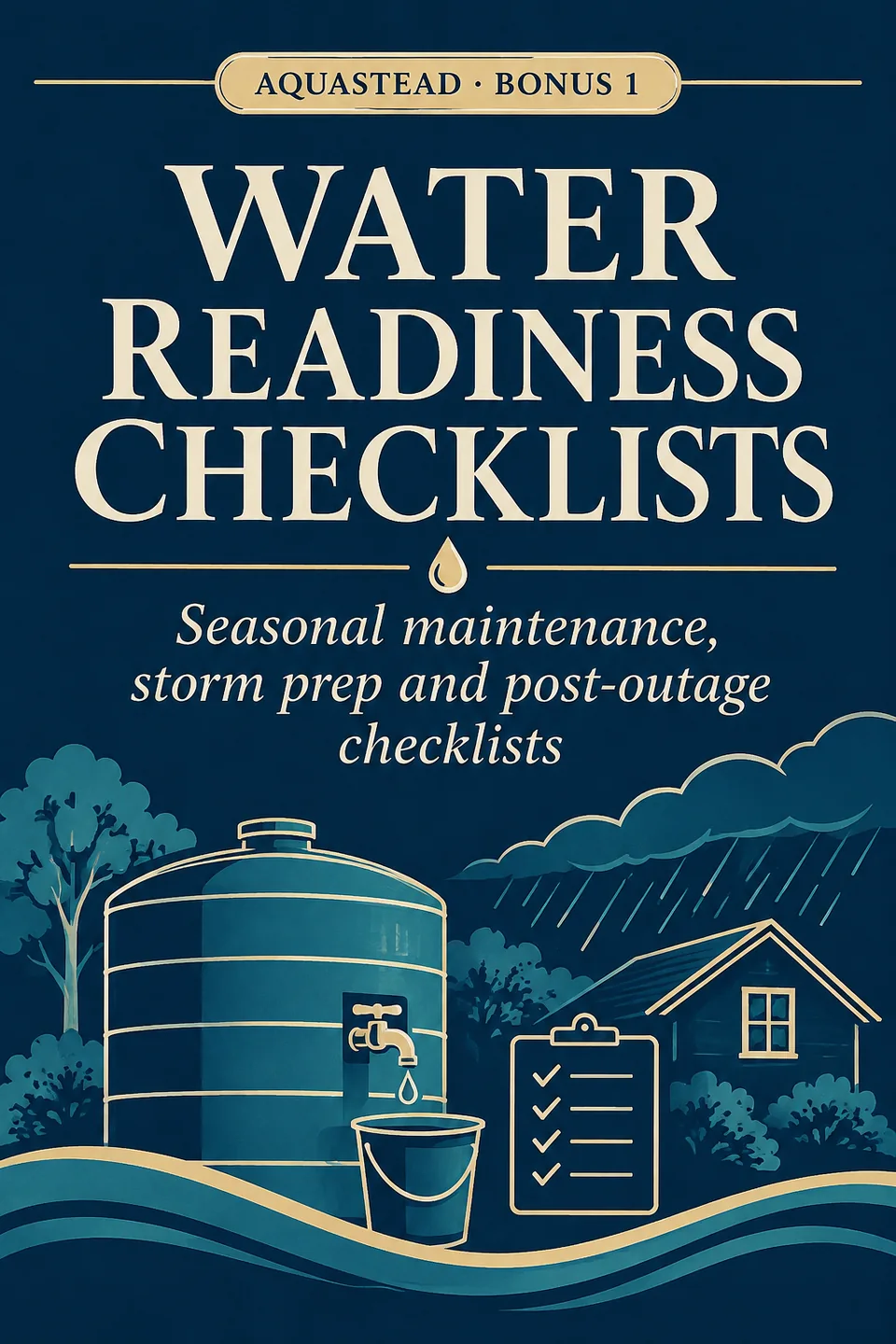
Water Readiness Checklists printable PDF coverINCLUDED FREE

BONUS 01

Water Readiness Checklists

$17 value · Our estimate if sold separately

Printable checklists for the jobs that are easy to forget:

  • Seasonal system maintenance
  • First-flush and gutter cleaning
  • Storage rotation
  • Pre-storm preparation
  • Post-outage recovery
  • Well and tank inspection

Stick them on the inside of a cupboard door and tick them off.

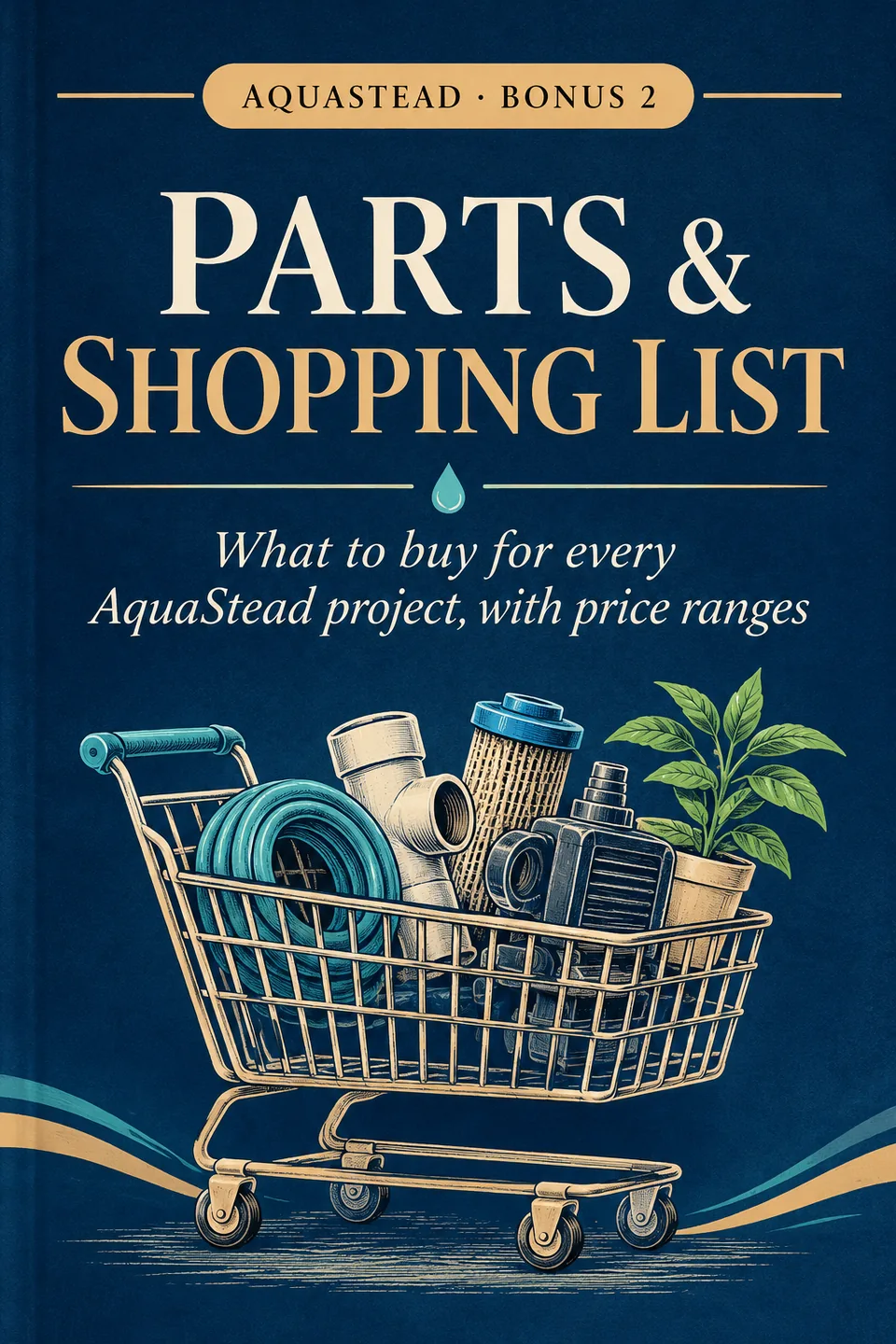
Parts & Shopping List printable PDF coverINCLUDED FREE

BONUS 02

Parts & Shopping List

$19 value · Our estimate if sold separately

Every component for a rain-barrel kit, an IBC tote system, first-flush diverters, filters, test kits and storage containers, with realistic US$ price ranges and what to look for (for example, the NSF/ANSI certifications that matter).

No affiliate links. We describe product types, not paid brand placements, so the list works wherever you shop.

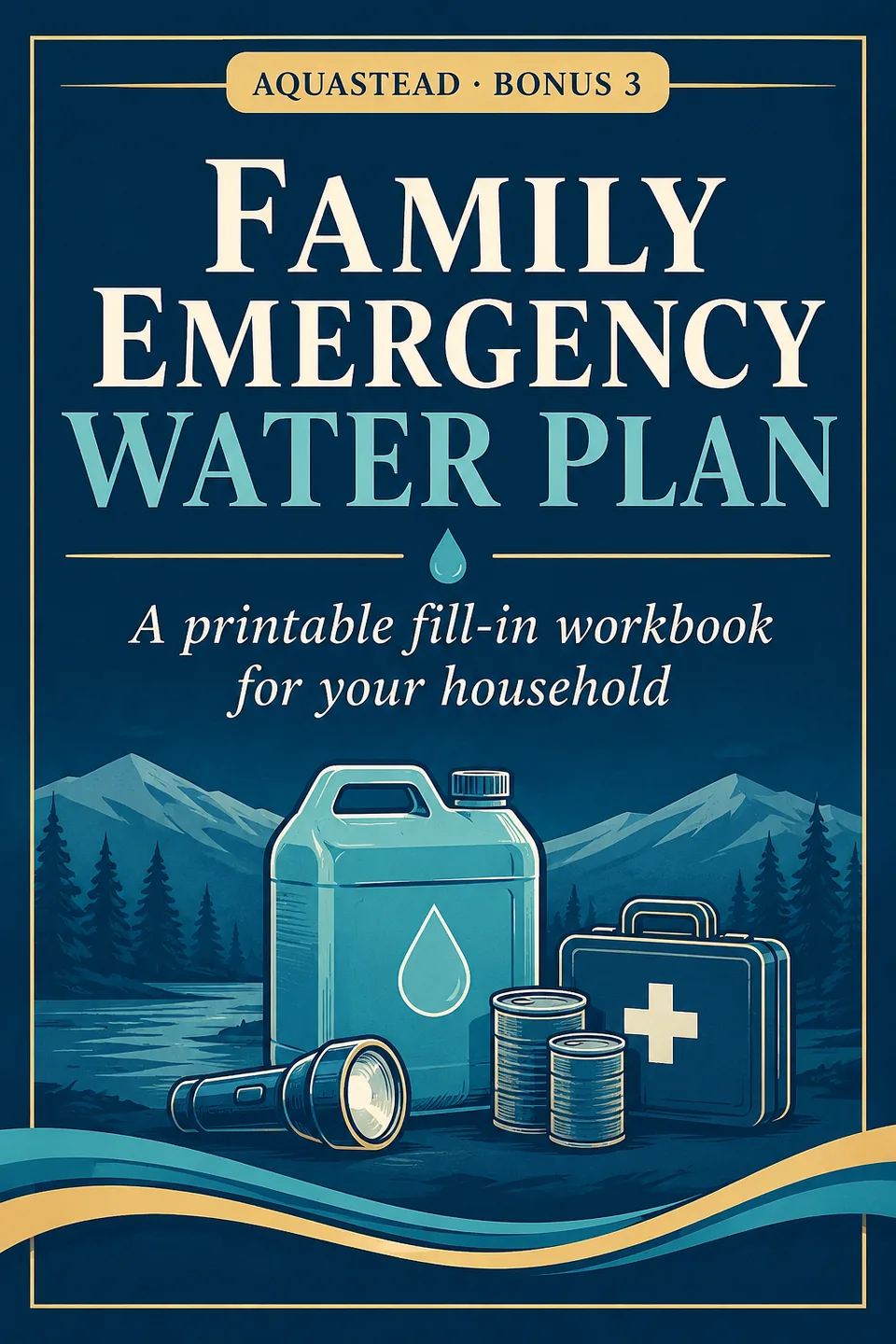
Printable Family Emergency Water Plan printable PDF coverINCLUDED FREE

BONUS 03

Printable Family Emergency Water Plan

$15 value · Our estimate if sold separately

Fill-in worksheets that turn this guide into your plan:

  • Household water-needs calculator
  • Storage inventory
  • Rotation log
  • Key contacts (utility, health department, plumber, neighbours)
  • Boil-water-notice step-by-step
  • Evacuation water kit

Fill it in once, keep it on the fridge, and everyone in the house knows what to do.

06 A SENSIBLE FIT

For people who prefer
a plan to a promise.

You’ll feel at home here if you…

  • Own (or look after) a home and want a sensible, practical water plan
  • Have been through a boil-water notice, a long outage, a storm, wildfire smoke or a drought, and thought "I should have been better prepared"
  • Are curious about rain barrels or tanks and want to do it properly: legally, safely and at a sensible cost
  • Have seen "water from air" ads and want the honest numbers before you spend money
  • Are on a private well and want a clear testing and emergency routine
  • Prefer calm, competent instructions to hype and doom
  • Like a weekend project, but also want to know when to call a professional

This guide won’t be the right fit if you…

  • Want a gadget that promises "unlimited free water". We'll tell you why that doesn't exist
  • Are looking for a guarantee of lower water bills. Savings are possible but often modest, and we say so
  • Want permission to skip testing or treatment. We won't give it
  • Need a licensed engineer to design a certified whole-house potable system. AquaStead will help you brief one, but it doesn't replace one
  • Want a printed hardcover. AquaStead is a digital PDF (you're welcome to print it)
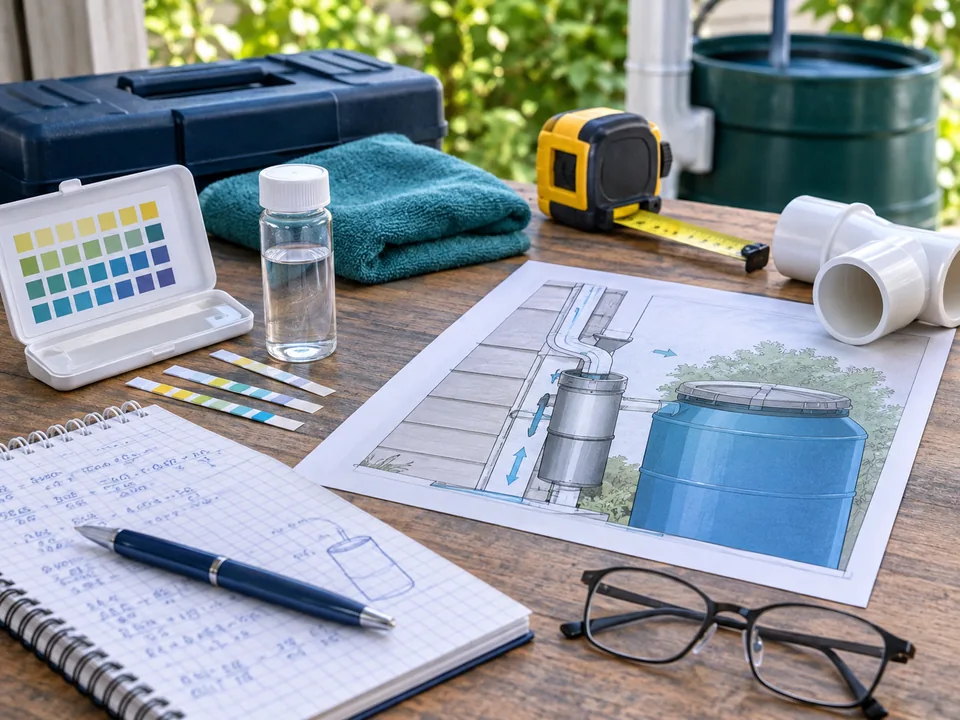
Research notes, a water test kit and a rainwater tank build plan on a desk

The details matter. So do the sources behind them.

07 THE PEOPLE BEHIND THE PAGES

Researched carefully.
Written plainly.

AquaStead is published by Magicka Games, and it was researched and written by the Magicka Games research team.

We'll be straight with you about who we are. We are not a government agency, and we are not licensed plumbers, engineers, hydrologists or medical professionals. We're researchers and writers who were frustrated by the state of water-preparedness information online: endless generic lists, risky forum advice, and products promising things the physics doesn't support.

So we did the slow work:

  • We read the primary guidance from the CDC, EPA, WHO, Health Canada and Australia's enHealth
  • We reviewed what the major standards cover, including NSF/ANSI drinking-water treatment standards, ARCSA/ASPE rainwater catchment standards, CSA B805 (Canada), BS EN 16941-1 (UK) and others, and described each one conservatively
  • We checked the math: harvest formulas, tank weights, dosing tables and unit conversions
  • We wrote it all up in plain English, with a source list at the end of every chapter so you can check our work

Where the evidence is mixed, we say so. Where you need a professional, we say so. Where something is a bad idea, we say that too.

A PLACE FOR REAL EXPERIENCES

Reader reviews

Only real, verified customer reviews belong here. No reviews have been added yet.

Testimonial placeholder — replace with a real, verified customer review

Testimonial placeholder — replace with a real, verified customer review

Testimonial placeholder — replace with a real, verified customer review

08 EVERYTHING YOU NEED TO GET STARTED

A practical plan.
A one-time decision.

The full blueprint and all three printable bonuses, together. No subscription, no upsell required, no monthly fee.

The AquaStead Blueprint12 chapters · Illustrated PDF · Build sheets & source lists$37
Water Readiness Checklists$17
Parts & Shopping List$19
Printable Family Emergency Water Plan$15
Total estimated separate value$88

Bonus values are our own estimates of what each item would sell for on its own. They’re included free with the guide. This is not a previous selling price.

THE COMPLETE AQUASTEAD BUNDLEThe complete digital AquaStead guide and bonus bundle
$37USD
one-time

Your blueprint. Your bonuses. Your next step.

Secure checkout · Instant PDF download

60-day money-back guarantee

Digital product. No physical book will be shipped.

Putting $37 in perspective

$37 is a one-time payment. No subscription, no upsell required, no monthly fee.

For comparison:

  • A single emergency plumber visit in the US averaged around $170 in the cited 2024 cost data, and after-hours jobs often cost several hundred dollars.10 Standard call-out fees alone commonly run $50–$200.11 AquaStead won't replace a plumber (you'll still need one for potable connections), but it can help you avoid paying for the wrong job, and help you brief a professional clearly when you do need one.
  • One bad buying decision, such as a filter that doesn't remove what you need it to, an undersized tank, or an atmospheric water unit that doesn't suit your climate, can easily cost more than this guide.
  • And the cost of not having a water plan during your next boil-water notice isn't measured in dollars. It's measured in stress, guesswork and trips to an empty store shelf.

We're not promising you'll save money. We're promising you'll know what to do, what to buy, what to skip, and how to do it safely.

60DAYS TO DECIDEMONEY-BACK GUARANTEE

READ IT. USE IT. DECIDE.

Take a full 60 days to decide.

Download AquaStead. Read it. Do the household water audit. Fill in the family plan. Walk around your roof line with the harvest formula. Look at the build sheets.

If, at any point in the next 60 days, you decide it isn't for you, for any reason, just email us at emaildevdude@gmail.com and we'll refund your $37 in full.

No hoops. No hard feelings. You can keep the bonuses.

We offer this because we're confident AquaStead is the most honest, practical water guide you'll find at this price, and because we'd rather earn your trust than argue about a refund.

09 GOOD QUESTIONS. STRAIGHT ANSWERS.

A little clarity
before you begin.

Something else on your mind?
Email our support team.

Is water from the air real?

Yes, but with important limits. Atmospheric water generators work like dehumidifiers: they cool air below its dew point so moisture condenses. It's proven physics. But it takes a lot of energy, and the yield depends heavily on humidity and temperature. Published research has measured roughly 1 kWh per litre in warm, humid conditions and over 6 kWh per litre in cooler conditions.9 In hot, humid climates it can be a useful supplement. In dry or cold climates it's usually expensive and slow. DIY dew and fog collection produce small amounts. Chapter 4 gives you the real numbers so you can decide for your climate. And no device produces "unlimited free water".

Is rainwater safe to drink?

Not automatically. Rain picks up dirt, bird droppings, debris and sometimes metals or chemicals from your roof and gutters. The CDC states that rainwater "is not necessarily safe to drink without first removing germs and chemicals from it" and recommends regular testing if you drink, cook or bathe with it.4 AquaStead shows you how to collect it more cleanly (first-flush diversion, screens, suitable roofs), how to treat it, and how to test it. For drinking, the CDC advises using a public supply or bottled water where available.4 Many people use harvested rainwater for gardens, flushing and cleaning, and keep treated stored water for drinking.

Is collecting rainwater legal where I live?

In most places, yes, but rules vary, sometimes a lot. In the US it's governed state by state and sometimes locally. For example, Colorado allows households up to two rain barrels with a combined 110 gallons, for outdoor non-potable use.8 Many other states actively encourage collection, and some offer incentives. Canada, the UK and Australia have their own standards and local rules, and some Australian programs have offered tank rebates. Chapter 2 and the Appendix explain the landscape, but always check your current state, provincial or local rules before you build.

Do I need special tools or skills?

No special skills for most of it. Storage, treatment, testing and planning need no tools at all. The starter rain-barrel build uses basic hand tools (a drill, hole saw, adjustable spanner/wrench and thread-seal tape). Larger builds like IBC tote stations need more care, mostly around a solid, level, load-bearing base. Each build sheet lists the difficulty, time, tools and approximate cost up front. For anything connected to drinking-water plumbing or electrical work, we recommend a licensed professional, and we tell you exactly when.

Is this a physical book?

No. AquaStead is a digital PDF that you download instantly after purchase. It works on a computer, tablet or phone, and it's laid out to print cleanly on standard Letter or A4 paper if you'd like a paper copy for the garage or the kitchen drawer. The bonuses are designed to be printed.

How do refunds work?

You're covered by our 60-day money-back guarantee. Email emaildevdude@gmail.com within 60 days of purchase and we'll refund you in full. No questions asked, and you can keep the bonuses.

Is my payment secure?

Yes. Checkout is handled by Stripe or PayPal over an encrypted (HTTPS/SSL) connection. We never see or store your full card details.

Is this a one-time payment or a subscription?

One-time. You pay $37 once. There's no subscription and no recurring charge.

I live in Canada / the UK / Australia. Will this work for me?

Yes. The core methods (storage, treatment, testing and planning) apply everywhere. We note regional standards and rules (Canada's CSA B805, the UK's BS EN 16941-1 and BS 8515, Australia's enHealth rainwater guidance) and include a conversions table for imperial gallons, litres, mm and m². Costs are shown in US dollars as a guide. Prices vary by region.

I'm on town water. Do I still need this?

Most readers are. Even reliable municipal systems have boil-water advisories, main breaks and pressure loss now and then. For calendar year 2021, the EPA identified about 4,000 advisories in the US.1 Layers 1 (Store) and 5 (Plan) are especially useful for town-water households, and rain barrels are a popular garden project in their own right.

Will this guarantee I save money on my water bill?

No, and we won't pretend otherwise. Some households reduce garden and outdoor water use with rainwater. For many, the bill savings are modest. Chapter 10 shows you honest payback math. The main value of AquaStead is resilience and peace of mind, not savings.

Is this medical advice?

No. AquaStead is general educational information about household water. If you or someone in your household is pregnant, elderly, immunocompromised or has a medical condition, follow your doctor's and local health authority's advice about drinking water.

THE NEXT STEP IS A SMALL ONE.

You can’t control when
the tap changes.
You can be ready.

A clear, layered plan. Honest numbers. Step-by-step build sheets. Safety-first treatment and testing. All three bonus guides.

One-time payment · Instant download · 60-day guarantee

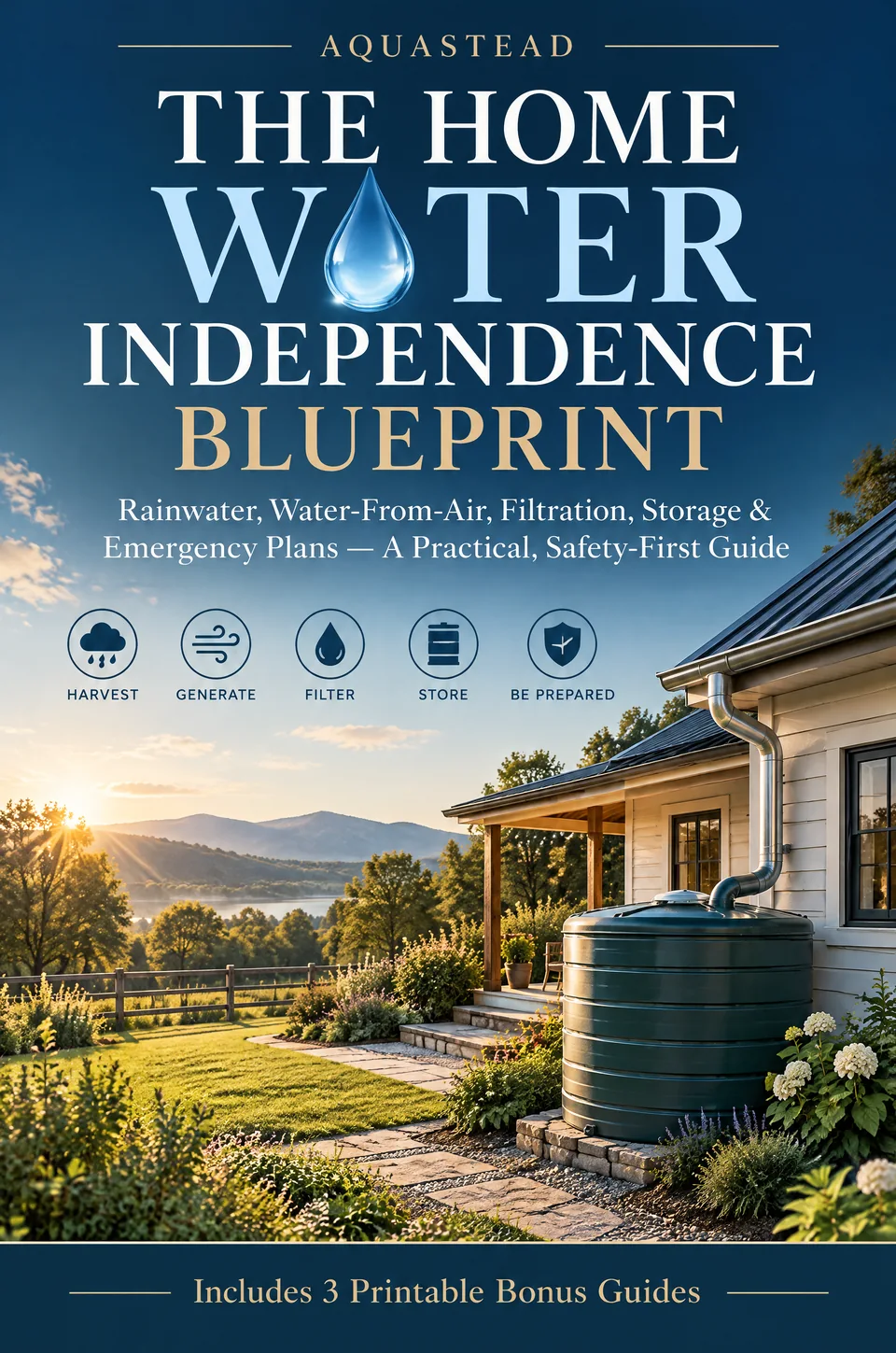
AquaStead: The Home Water Independence Blueprint digital guide cover

P.S. If you only do one thing after reading this page, make it the Chapter 0 "first weekend" plan. It's a short list of jobs that takes most households from "a few bottles somewhere" to a sensible, labelled, 72-hour water baseline. It's the easiest win in the whole guide, and it's covered by our 60-day guarantee.

P.P.S. Seen a "water from thin air" ad and wondered if it's real? Chapter 4 alone could save you from an expensive mistake, or show you that atmospheric water genuinely makes sense in your climate. Either way, you'll decide with real numbers.

WE’RE HERE TO HELP

A question, a download,
or a change of mind.

For help with an order or download, email us and include your order number if you have it.

emaildevdude@gmail.com

Need a refund? Email within 60 days of purchase for a full $37 refund. No questions asked. You can keep the bonuses.

Published by Magicka Games.

CHECK THE WORK

Sources & further reading

Primary guidance behind the guide. References are citations, not endorsements. Figures below describe the stated year, not current conditions.

  1. U.S. Environmental Protection Agency, National Occurrence and Causes of Boil Water Advisories in the United States: Report to Congress (EPA 810-R-24-003), May 2024. Covers calendar year 2021. The "roughly 4,000" total is derived from the report's stated category counts and percentages (e.g. 3,221 advisories = 80%). The report notes that state tracking data are incomplete. https://19january2025snapshot.epa.gov/system/files/documents/2025-01/10586_boil-water-advisories_final_rtc_20240603_admin.pdf
  2. Centers for Disease Control and Prevention, "How to Create an Emergency Water Supply," updated June 2025. ("Store at least 1 gallon of water per person, per day for 3 days… Try to store a 2-week supply if possible"; replace self-filled water every 6 months; use FDA-approved food-grade containers.) https://www.cdc.gov/water-emergency/about/how-to-create-and-store-an-emergency-water-supply.html
  3. Centers for Disease Control and Prevention, "Boil Water Advisory" (natural disasters PSA toolkit). (Rolling boil for 1 minute; 3 minutes above 6,500 ft; boiling does not remove chemicals; use boiled or bottled water for brushing teeth.) https://www.cdc.gov/natural-disasters/psa-toolkit/boil-water-advisory.html
  4. Centers for Disease Control and Prevention, "Collecting Rainwater and Your Health: An Overview," July 2024. https://www.cdc.gov/drinking-water/about/collecting-rainwater-and-your-health-an-overview.html
  5. U.S. Energy Information Administration, Today in Energy: U.S. electricity customers averaged about 11 hours of interruptions in 2024 (Electric Power Annual 2024). https://www.eia.gov/todayinenergy/detail.php?id=66744
  6. American Society of Civil Engineers, 2021 Report Card for America's Infrastructure: Drinking Water (grade C-; a water main break about every two minutes). https://infrastructurereportcard.org/wp-content/uploads/2020/12/National_IRC_2021-report-2.pdf (2021 report; the figure quoted above is a historical estimate)
  7. National Integrated Drought Information System (Drought.gov), "Western Drought Status Update," September 3, 2025 (65.5% of the western U.S. in drought as of the August 26, 2025 U.S. Drought Monitor). https://www.drought.gov/news/western-drought-issue-2025-09-03
  8. Colorado Division of Water Resources, "Rainwater, Storm Water & Graywater" (HB16-1005: up to two rain barrels, 110 gallons combined, outdoor use). https://dwr.colorado.gov/services/water-administration/rainwater-storm-water-graywater
  9. Bagheri, F. & Bahrami, M., "Performance and limitations of atmospheric water generation heat pumps" (International Institute of Refrigeration), 2017. Measured ~1.02 kWh/L (warm, humid) to ~6.23 kWh/L (cold, humid). https://iifiir.org/en/fridoc/performance-and-limitations-of-atmospheric-water-generation-heat-pumps-33410 · See also Brenes, A. & Chini, C., Environmental Research: Infrastructure and Sustainability, 2023 (modelled AWG energy use across the continental U.S.). https://doaj.org/article/c7badc384ecc4df28d820a65488d4ec7
  10. Angi, "How Much Does an Emergency Plumber Cost?" (2024 data; average ~$170, ranging from about $60 to $600 per hour depending on timing and job). https://www.angi.com/articles/emergency-plumber-cost.htm
  11. HomeGuide, "How Much Does a Plumber Cost?" (service call/call-out fees commonly $50–$200). https://homeguide.com/costs/plumber-cost
  12. Association of Public Health Laboratories, Private Wells: Sampling and Testing — A Guide for Public Health Laboratories (approximately 13 million U.S. households rely on private wells). https://aphl.org/resources/resource-detail/private-wells-sampling-and-testing--a-guide-for-public-health-laboratories

YOUR HOUSEHOLD WATER PLAN

Choose how to pay

AquaStead + all 3 printable bonuses.
$37 USD · One-time payment.

VisaMastercardAmexApple PayGoogle Pay
or

Secure checkout · 60-day money-back guarantee

You’ll continue to Stripe or PayPal to complete your order. By purchasing, you agree to our terms of sale.

AquaStead$37 once · 4 PDFs